
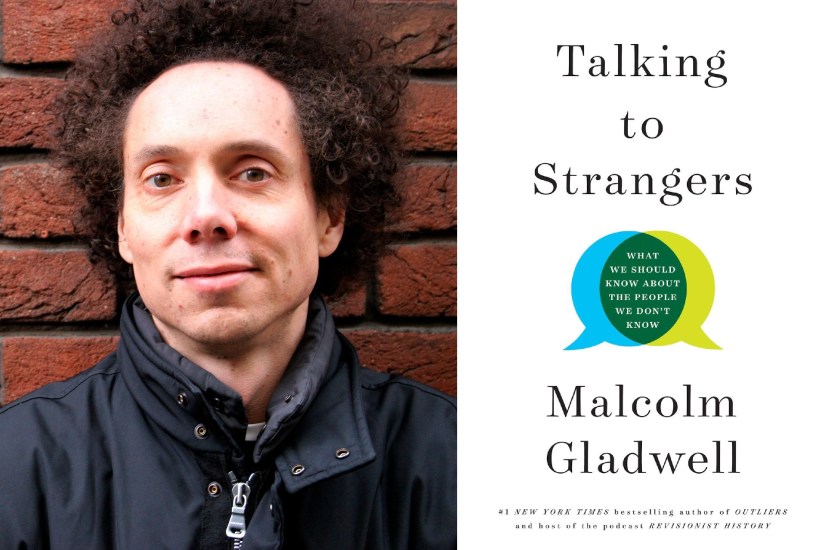
In the book Talking to Strangers: What we Should Know about the People We Don’t Know, Malcolm Gladwell conducts extensive research in the lives of police officers who misinterpret the intentions of motorists, experienced judges who allow dangerous criminals to roam free, intelligence officers who fail to recognize that their colleagues might be double agents, parents who cannot even assume that their daughter’s coach is a pedophile, and teenagers who don’t know what the opposite gender would do and how they would reveal their true intention while intoxicated.
All the evidence proves that we are poor at understanding strangers even though we think we are good and that we are only 51% good at knowing whether someone is telling the truth or not, better to flip a coin! The reason for this is two fold: the first is dubbed the Truth Default Theory and the second is called Transparency.
.
The Truth Default Theory states that we all have a bias to believe other people more than we have a bias not to believe them and that has been necessary throughout the history of humanity so as to make living and functioning in group settings and societies possible but defaulting to truth means that in order for us to feel secure and have normal lives devoid of constant mistrust and fear we end up trusting and cooperating with those we should not.
.
The error of transparency is another serious issue when it comes to misunderstanding strangers, we assume that what people show on the outside is what they actually feel on the inside. There is a false myth that all facial expressions are universal but research done by anthropologists proves that facial expressions are tied to the location and the culture of the individual as well as his or her unique temperament. This means relying solely on facial expressions is flawed and unreliable when dealing with strangers who might come from a different background.
.
Additionally people can fake facial expressions or even emotions which make them mismatched, that is how they seem on the outside is not how they feel on the inside. When people are mismatched and they go unnoticed because of transparency fallacy then people like Bernie Madoff can run Ponzi schemes and dangerous criminals can be let go by experienced judges!
.
The last main issue covered in the book is coupling and that by solely looking at the person and making judgments right then and there, we fail to take into consideration the cultural and environmental factors that play a major role in how they act and what attitudes they have. This means that we won’t be able to understand the context in which the stranger is operating.
.
Ultimately, by becoming aware of our inherent incompetence at understanding strangers and being cognizant of the three errors of defaulting to truth, transparency, and coupling we become far more careful when it comes to judging the characters and intentions of others if not more adept.

 Daniel Molgan Official