Blog

real-estate

U.S. Real Estate Market in October 2026: What’s Next for House Flipping and Rental Investments?

A Closer Look at National Housing Trends and Investment Opportunities in Maryland

October 9, 2026 | Real Estate Market Insights

The American real estate market continues to evolve in 2026, bringing new challenges and opportunities for homeowners, buyers, and investors. With mortgage rates remaining elevated, housing inventory gradually increasing, and buyers becoming more selective, the market is entering a period of adjustment.

For real estate investors, particularly those involved in house flipping and rental properties, these changes are reshaping how profitable deals are identified and executed.

While some regions are experiencing slower sales and price reductions, others continue to demonstrate resilience. Maryland, especially the Baltimore metropolitan area, remains an interesting market for investors looking to renovate properties, generate rental income, or build long term wealth through real estate.

So, what does the housing market look like in October 2026, and where are the opportunities?

The U.S. Housing Market: A Slower but More Balanced Environment

After several years of intense competition and rapidly rising property prices, the U.S. housing market is showing signs of becoming more balanced.

According to the National Association of Realtors, existing home sales declined by approximately 2% in August 2026, reaching an annualized rate of 3.98 million transactions. Meanwhile, the median existing home price stood at approximately $429,100, representing a modest annual increase of 1.6%.

One of the most notable developments is the gradual increase in housing inventory. With approximately 1.62 million homes available for sale nationwide, buyers now have more options than they did during the exceptionally competitive housing market of previous years.

For sellers, this means greater competition and potentially longer listing periods. For buyers and investors, however, it creates opportunities to negotiate more favorable purchase prices.

Mortgage rates remain another major factor influencing the market. Elevated borrowing costs continue to make homeownership expensive for many Americans, particularly first time buyers.

As a result, some prospective homeowners are postponing purchases, while others are looking for smaller or more affordable properties.

This shift is particularly important for investors who specialize in renovating entry level homes.

Although the market is moving more slowly, demand for reasonably priced, move in ready properties remains an important source of opportunity.

House Flipping in 2026: Still Profitable, but More Competitive

House flipping has long attracted investors seeking to generate profits by purchasing undervalued properties, renovating them, and reselling them at higher prices.

However, the economics of flipping have changed considerably.

According to ATTOM’s second quarter 2026 home flipping report, approximately 77,991 homes were flipped across the United States, accounting for 6.2% of residential sales.

The typical gross profit from a flipped property was approximately $60,526, while the gross return on investment stood at 21.5%.

These figures suggest that flipping remains an active segment of the housing market, although profit margins have come under pressure.

Higher renovation costs, expensive financing, and slower resale activity have made it increasingly difficult for investors to achieve the returns that were common during the housing boom.

One of the biggest challenges is the cost of holding a property.

When a renovated home takes several additional months to sell, investors must continue paying interest, insurance, utilities, taxes, and other expenses.

At the same time, buyers facing high mortgage payments may negotiate more aggressively, putting additional pressure on resale prices.

Nevertheless, opportunities remain available for experienced investors.

Properties requiring cosmetic improvements, outdated homes in desirable neighborhoods, and distressed properties purchased at substantial discounts can still offer attractive returns.

The key difference in 2026 is that investors must be more selective.

Rather than assuming that rising home prices will compensate for mistakes, successful flippers increasingly rely on accurate property valuations, efficient renovations, and realistic resale expectations.

In today’s market, the purchase price often determines whether a flip becomes a profitable investment or an expensive mistake.

Rental Properties Are Gaining Attention

While house flipping faces tighter margins, rental properties continue to attract investors seeking recurring income and long term financial stability.

The combination of high mortgage rates and expensive home prices has made homeownership less accessible for many households.

As a result, renting remains a practical option for millions of Americans.

According to Zillow’s September 2026 market report, the typical monthly rent nationwide reached approximately $1,932, representing an annual increase of 2.7%.

Although rental growth varies significantly between cities, the broader trend highlights the continued importance of rental housing in the American economy.

For investors, rental properties offer several potential advantages.

Unlike flipping, where profits generally depend on selling the property, rentals can generate monthly income while allowing owners to benefit from long term appreciation.

Rental properties can also provide opportunities to build equity as mortgage balances decline over time.

However, owning rental real estate is not without challenges.

Insurance premiums, property taxes, maintenance costs, and financing expenses can significantly affect profitability.

Investors must also consider vacancy periods, tenant turnover, and local housing regulations.

In 2026, the most attractive rental properties are not necessarily those commanding the highest rents. Instead, they are properties purchased at prices that allow investors to maintain healthy cash flow after expenses.

Maryland Real Estate: A Market Worth Watching

Maryland remains an interesting destination for residential real estate investors because of its economic diversity, established communities, and proximity to major employment centers.

The state’s economy benefits from healthcare, education, government employment, biotechnology, defense contracting, and professional services.

These industries help support housing demand across much of the state, particularly in communities surrounding Baltimore, Annapolis, and Washington, D.C.

Recent housing data indicate that Maryland is experiencing many of the same changes affecting the national market.

According to Realtor.com’s September 2026 market figures, Maryland’s median listing price was approximately $425,000, while the median sold price reached around $435,000.

Housing inventory increased by nearly 10% compared with the previous year, and properties spent a median of approximately 46 days on the market.

These developments suggest that buyers are gaining somewhat more negotiating power.

For investors, increasing inventory may create opportunities to acquire properties from motivated sellers, particularly homes requiring repairs or those that have remained unsold for extended periods.

However, Maryland is not a single, uniform housing market.

Property values and investment opportunities vary considerably between Baltimore City, Baltimore County, Anne Arundel County, Howard County, and the Washington metropolitan area.

Understanding these local differences is essential.

Why Maryland Remains Attractive for House Flippers

Despite the challenges facing the national flipping industry, Maryland has continued to demonstrate relatively strong investment returns.

According to ATTOM’s second quarter 2026 figures, the typical gross profit on a flipped property in Maryland reached approximately $130,000, with a gross return on investment of around 51%.

That is substantially higher than the national gross profit of approximately $60,526.

However, Maryland’s flipping margins have also declined compared with the previous year.

This suggests that while profitable opportunities remain, investors must exercise greater caution when evaluating potential projects.

It is also important to remember that gross flipping profits do not include all renovation, financing, and transaction expenses.

For experienced investors, Maryland’s appeal lies partly in its diverse housing stock.

Older properties in established neighborhoods can often be modernized to meet the expectations of today’s homebuyers.

Updated kitchens, renovated bathrooms, improved energy efficiency, and modern living spaces can make older homes more competitive.

Still, not every renovation adds enough value to justify its cost.

Investors must carefully evaluate neighborhood prices and avoid overimproving properties beyond what local buyers are willing to pay.

Baltimore: One of Maryland’s Most Interesting Investment Markets

Among Maryland’s major housing markets, Baltimore continues to attract attention from investors specializing in residential rehabilitation and rental properties.

The city offers a large inventory of older rowhouses, townhouses, and single family homes, many of which present opportunities for renovation.

Compared with the more expensive Washington metropolitan area, Baltimore also offers relatively accessible property prices.

According to September 2026 market figures, Baltimore City’s median listing price was approximately $230,000, significantly below Maryland’s statewide median.

This affordability creates opportunities for investors operating with smaller acquisition budgets.

However, Baltimore’s real estate market requires particularly careful analysis.

Neighborhood conditions can vary dramatically, sometimes within just a few blocks.

A renovated property in one neighborhood may attract strong buyer demand, while a similar property nearby may struggle to sell.

Factors such as property condition, neighborhood stability, local employment, schools, transportation access, and comparable sales all influence investment performance.

For house flippers, the most promising opportunities are often found where acquisition prices remain reasonable but demand for renovated homes is established.

Investors should also pay close attention to structural repairs, roofing, plumbing, electrical systems, and other potential expenses associated with Baltimore’s older housing stock.

A low purchase price does not automatically mean a property is a good investment.

Baltimore County and Surrounding Communities Offer Different Opportunities

While Baltimore City attracts investors seeking affordable rehabilitation projects, surrounding suburban communities offer different investment possibilities.

Areas such as Catonsville, Towson, Parkville, Pikesville, and Dundalk feature a variety of housing types and price points.

Some communities appeal to buyers seeking established residential neighborhoods, access to employment centers, and proximity to Baltimore.

Others offer more affordable properties that may be suitable for renovation or rental investment.

Baltimore County’s median listing price was approximately $390,000 in September 2026, considerably higher than Baltimore City’s.

For investors, higher acquisition prices can mean greater capital requirements and potentially narrower profit margins.

However, certain suburban neighborhoods may offer strong demand for renovated family homes.

Beyond Baltimore County, parts of Anne Arundel and Harford counties may also present opportunities for investors willing to evaluate different price ranges and property types.

The important consideration is matching the investment strategy to the characteristics of each local market.

A property suitable for a profitable flip may not necessarily make an attractive rental investment, and vice versa.

Is Renting Better Than Flipping in Maryland Right Now?

One of the biggest questions facing real estate investors in 2026 is whether they should focus on flipping properties or holding them as rentals.

The answer depends largely on investment goals, financing conditions, and the individual property.

For investors seeking faster capital turnover, house flipping remains appealing.

A successful flip allows investors to recover their capital and reinvest in additional projects without committing to years of property management.

However, flipping also carries greater exposure to short term market conditions.

Unexpected renovation expenses, declining resale prices, or prolonged listing periods can significantly reduce profits.

Rental properties offer a different approach.

Investors can generate recurring income while gradually building equity.

In Baltimore, relatively affordable property prices may allow investors to achieve attractive rental yields when properties are purchased and renovated efficiently.

For example, a renovated townhouse acquired at a total cost of $170,000 and rented for $1,700 per month would generate approximately $20,400 in annual gross rental income.

That represents a gross yield of around 12%, before accounting for taxes, insurance, vacancy, maintenance, management, and financing.

Although this is only an illustrative example, it demonstrates why Baltimore continues to attract rental investors.

The challenge is ensuring that actual expenses do not consume too much of the rental income.

For some investors, a combination of both strategies may offer the greatest flexibility.

Profits from successful flips can help finance the acquisition of rental properties, gradually creating a portfolio that combines active investment income with long term wealth accumulation.

What Should Investors Expect in 2027?

Looking ahead, the direction of mortgage rates will remain one of the most important factors influencing the American housing market.

If borrowing costs decline, more buyers may return to the market, potentially supporting sales activity and property values.

However, if rates remain elevated, affordability challenges could continue limiting demand.

For house flippers, this means that conservative resale projections will remain essential.

For rental investors, sustained demand for affordable housing could continue creating opportunities, particularly in established employment markets.

Maryland’s economic foundations may help support residential demand, although individual neighborhoods will continue to perform differently.

Baltimore, in particular, is likely to remain a market where local knowledge makes a significant difference.

Investors who understand neighborhood conditions, renovation costs, and realistic resale values may be better positioned to identify profitable opportunities than those relying on broad market trends.

Another important development is the growing emphasis on property quality.

Today’s buyers increasingly expect renovated homes to offer modern finishes, functional layouts, and energy efficient features.

For investors, thoughtful renovations that improve comfort and reduce operating costs may become increasingly valuable.

Final Thoughts: Opportunities Remain for Investors Who Adapt

The U.S. real estate market in October 2026 is experiencing a period of adjustment rather than a uniform downturn.

Home sales have slowed, borrowing costs remain elevated, and buyers are becoming more cautious. At the same time, increasing housing inventory is creating new opportunities for investors who know where to look.

House flipping remains profitable in certain markets, but declining margins mean that careful acquisitions and efficient renovations are more important than ever.

Rental properties continue to offer opportunities for investors seeking recurring income, particularly as homeownership affordability remains a challenge for many Americans.

Maryland stands out because of its diverse housing markets and relatively strong historical flipping returns.

Within the state, Baltimore and its surrounding communities offer a broad range of opportunities, from renovating older city rowhouses to acquiring suburban properties for resale or rental income.

Ultimately, success in today’s real estate market depends less on predicting future price increases and more on understanding property values, managing costs, and making disciplined investment decisions.

For investors willing to adapt to changing market conditions, 2026 may prove to be a year of opportunity rather than uncertainty.

Disclaimer: This article is intended for general informational purposes and does not constitute financial or investment advice. Housing market conditions vary by location, and investors should conduct independent research before making investment decisions. Figures reflect reports available as of October 9, 2026.

Sources

National Association of Realtors: Existing Home Sales Statistics

ATTOM: U.S. Home Flipping Trends

Realtor.com: Maryland Housing Market

Freddie Mac: Mortgage Market Survey

Business & Work, real-estate

House Flipping in 2026: Why Experienced Investors Continue to Thrive While Others Sit on the Sidelines

For years, real estate investors have debated whether house flipping remains a viable investment strategy. Rising interest rates, elevated construction costs, labor shortages, and shifting market conditions have led many to question whether the profits that once defined the industry are still achievable. Some investors argue that the golden age of flipping has passed, while others continue to report strong returns and growing portfolios.

The reality lies somewhere between these two perspectives. House flipping is neither dead nor effortless. Rather, it has evolved into a business that rewards discipline, local market knowledge, and operational efficiency. Investors who rely on speculation or appreciation alone often struggle in today’s environment. Those who consistently create value through strategic acquisitions and well-managed renovations continue to find profitable opportunities across the country.

This is particularly true in states such as Maryland, where strong employment centers, limited housing inventory, and aging housing stock continue to create opportunities for investors willing to approach projects with the right strategy.

Success Begins Long Before the Property Hits the Market

One of the most common misconceptions among new investors is that profitable deals are found exclusively on the Multiple Listing Service. While opportunities occasionally emerge through traditional channels, many of the most successful flippers spend far more time building relationships than searching online listings.

The ability to source opportunities before they become widely available often provides a significant competitive advantage. Relationships with wholesalers, real estate agents, probate attorneys, estate executors, contractors, and local property owners frequently generate leads that never reach the open market.

In competitive markets such as Baltimore, the Washington metropolitan area, and other major regions throughout the United States, investors who consistently secure profitable projects are often those who have established themselves as reliable buyers. Sellers value certainty and speed, particularly when dealing with inherited properties, distressed assets, or homes requiring significant updates. Investors who can quickly evaluate a property and confidently submit an offer often outperform competitors who spend weeks analyzing every detail.

Understanding What Truly Causes a Flip to Fail

Many inexperienced investors assume that rising interest rates represent the greatest threat to profitability. While financing costs certainly affect project returns, they are rarely the primary reason a flip underperforms.

In most cases, the greatest danger comes from renovation surprises and inadequate project planning.

A property that appears to require only cosmetic improvements can quickly reveal hidden issues once demolition begins. Aging electrical systems, plumbing failures, foundation concerns, water damage, and structural deficiencies can dramatically increase renovation budgets and extend project timelines. As delays accumulate, carrying costs continue to grow through loan payments, insurance premiums, utilities, and property taxes.

Experienced investors recognize that unexpected discoveries are not exceptions. They are an expected part of the business. Rather than hoping problems will not occur, successful flippers incorporate contingency reserves into every project and carefully evaluate worst-case scenarios before making an acquisition.

Why Simplicity Often Produces the Highest Returns

New investors are frequently attracted to highly distressed properties because they appear to offer the largest profit margins. However, these projects often require extensive experience and can expose beginners to substantial financial risk.

For most investors, particularly those completing their first few transactions, the ideal project is a property that is outdated but structurally sound. Homes requiring cosmetic improvements such as updated kitchens, renovated bathrooms, fresh paint, modern flooring, and improved curb appeal tend to offer a more predictable renovation process.

These projects are easier to estimate, easier to manage, and generally attract a broader pool of retail buyers upon completion. The reduced complexity also minimizes the likelihood of significant cost overruns that can quickly eliminate anticipated profits.

Across Maryland, many attractive opportunities exist within established suburban neighborhoods where homes have been owned by the same families for decades. While these properties may appear dated compared to newer construction, they often require modernization rather than major structural rehabilitation, making them particularly appealing to value-add investors.

Maryland Continues to Offer Attractive Opportunities for Flippers

Despite economic uncertainty in some sectors, Maryland remains one of the more resilient housing markets in the United States. The state’s economy benefits from a diverse mix of government employment, healthcare institutions, higher education, defense contracting, and technology companies.

This economic stability supports consistent housing demand throughout many regions of the state. Communities surrounding Baltimore, Annapolis, Frederick, and the Washington D.C. commuter corridor continue to attract both owner occupants and investors.

Additionally, much of Maryland’s housing inventory was built decades ago, creating ongoing demand for renovated homes that offer modern finishes and updated systems. As buyers increasingly seek move-in-ready properties, investors who can transform outdated homes into desirable residences often find strong resale demand.

The strongest opportunities are not always located in the hottest neighborhoods. In many cases, the greatest returns can be achieved in areas experiencing gradual improvement, where acquisition costs remain reasonable but buyer demand continues to strengthen.

Financing Matters, But Execution Matters More

Financing remains an essential component of any successful flipping operation. Hard money loans, private lenders, business lines of credit, and strategic partnerships continue to provide capital for thousands of projects nationwide.

However, sophisticated investors understand that securing financing is only one piece of the equation. More important is understanding the complete financial picture of a project.

Successful flippers carefully analyze acquisition costs, renovation budgets, financing expenses, carrying costs, selling expenses, and projected timelines before committing capital. They understand precisely how much profit remains available after accounting for every anticipated expense. A well-structured project can remain profitable even in a higher-interest-rate environment. Conversely, a poorly purchased property can struggle regardless of how inexpensive the financing may be.

The Psychological Side of House Flipping

While real estate investing is often viewed primarily as a financial endeavor, many experienced investors will tell you that success depends just as much on mindset as it does on numbers.

Unlike traditional employment, flipping does not provide predictable income. Investors may spend months managing renovations, solving problems, and coordinating contractors before realizing any return on their efforts. During that period, uncertainty is unavoidable.

The most successful investors learn to focus on process rather than immediate results. They understand that temporary setbacks are part of the business and avoid making emotional decisions based on short-term challenges. Their confidence comes not from hope, but from experience, preparation, and disciplined execution.

Experience Creates an Advantage That Cannot Be Taught

One of the most valuable assets a seasoned investor develops is pattern recognition. While spreadsheets, comparable sales analyses, and financial models remain important tools, experience provides insights that cannot be replicated by software alone.

Over time, investors begin to recognize which renovations buyers value most, which neighborhoods attract consistent demand, and which warning signs should not be ignored. They become more accurate in their pricing assumptions, more efficient in their renovation decisions, and more confident in their ability to evaluate risk.

This expertise is not acquired through courses or social media content. It is developed through years of evaluating properties, completing projects, and learning from both successes and mistakes.

Final Thoughts

House flipping in 2026 remains a highly viable investment strategy for those willing to approach it as a business rather than a speculative venture.

The era of easy profits driven solely by appreciation may be behind us. However, opportunities continue to exist for investors who understand their markets, manage risk effectively, and focus on creating genuine value through thoughtful renovations. Whether investing in Maryland, Pennsylvania, Texas, Florida, or elsewhere across the United States, the fundamentals remain unchanged. Successful investors buy carefully, renovate strategically, manage costs relentlessly, and rely on disciplined execution rather than market optimism.

Those who embrace these principles will continue to find opportunities regardless of market cycles, interest rates, or headlines.

real-estate

The New Real Estate Battlefield: How Corporate Landlords Are Quietly Re-entering the Market

For years, policymakers have tried to limit the influence of large institutional investors in the single-family housing market. The intention was straightforward. Give everyday buyers and smaller investors a fair chance to compete.

But real estate has always been a game of adaptation. When one path is blocked, capital rarely retreats. It simply finds another route.

That is exactly what is happening now.

A Shift That Few Saw Coming

Recent restrictions targeting corporate ownership of housing were designed to curb large-scale acquisitions of standard homes. On paper, this looked like a meaningful step toward rebalancing the market.

In practice, it has done something else entirely.

Instead of stepping away, institutional investors have shifted their focus. They are now moving toward distressed and underperforming properties, the very segment that has long been the foundation for independent investors. Rather than competing for finished homes, they are entering the value-add space, where renovations, repositioning, and operational improvements create profit.

This is not a retreat. It is a repositioning.

Why This Changes the Game

At first glance, this may appear to be a minor adjustment in strategy. It is not. It represents a deeper structural shift in how competition unfolds across the housing market.

Large firms bring a different level of power into any segment they enter. Their access to capital allows them to absorb thinner margins. Their systems allow them to evaluate and act on opportunities at a speed that individual investors cannot easily match. Their scale allows them to operate across multiple markets simultaneously, adjusting strategy in real time.

When that kind of capability enters the value-add space, the pressure on smaller investors increases immediately. Deals become more competitive. Prices begin to rise. Margins tighten in ways that are not always obvious at first, but become clear over time.

The Logic Behind the Move

This transition is not accidental. It is the natural outcome of how the current regulatory environment is structured.

Many of the policies aimed at institutional investors focus on limiting the accumulation of finished, move-in-ready homes. However, they often leave room for activity that adds supply or improves existing housing stock. Renovating distressed properties or developing new rental inventory falls into this category.

As a result, institutional capital is not excluded from the market. It is simply redirected into areas that remain permissible. The value-add segment becomes the ideal entry point because it aligns with both regulatory allowances and profit potential.

Pressure on the Traditional Investor Model

For smaller investors, this creates a new kind of challenge.

The traditional approach of finding undervalued properties, improving them, and either selling or renting them has relied on a certain level of inefficiency in the market. When large players begin targeting the same opportunities, those inefficiencies shrink.

Speed becomes a critical factor. Access to deals becomes more competitive. Even the definition of a “good deal” starts to change as pricing adjusts to reflect increased demand from well-capitalized buyers.

This does not eliminate opportunity, but it does change the conditions under which opportunity exists.

Where Opportunity Still Lives

What makes this shift interesting is that it does not close the market. It reshapes it.

Institutional investors tend to favor scale, predictability, and repeatable models. They are less comfortable in situations that require deep local knowledge, unconventional problem-solving, or highly customized execution. This creates space for smaller investors who are willing to operate in areas that are less standardized.

Success, in this environment, becomes less about competing directly and more about positioning differently. Investors who understand their local markets at a granular level, who can move quickly without layers of approval, and who are comfortable navigating complexity will continue to find opportunities.

The Broader Pattern

This moment reflects a larger pattern that has always defined real estate.

Regulation does not eliminate capital. It redirects it.

Whenever new rules are introduced, they create both constraints and openings. Those who adapt quickly to the new landscape tend to benefit, while those who rely on old assumptions often find themselves squeezed out.

What we are seeing now is simply the latest version of that cycle.

The Evolution of Competition

The idea that restricting institutional investors would fully level the playing field was always optimistic. Capital does not exit markets easily, especially not one as fundamental as housing.

Instead, it evolves.

And today, that evolution is bringing large investors directly into the territory that independent operators have relied on for years.

The question is no longer whether competition will increase. It already has.

The real question is who will adapt fast enough to stay ahead of it.

real-estate

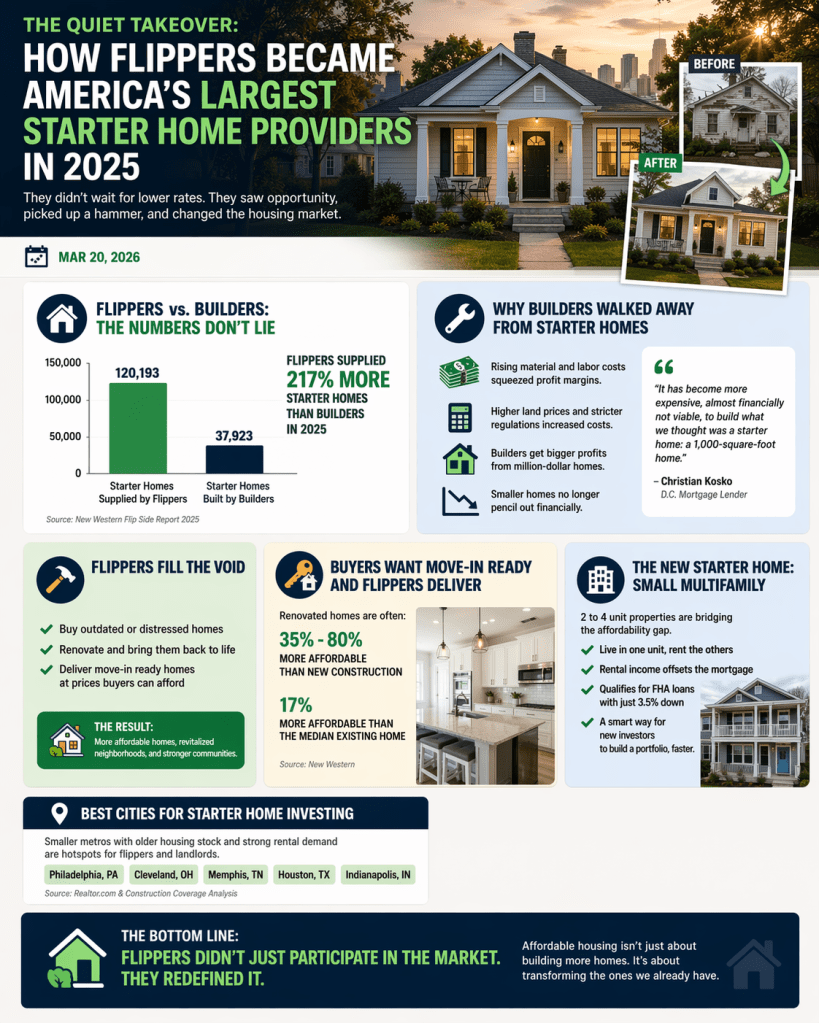
The Quiet Takeover: How Flippers Became America’s Largest Starter Home Providers in 2025

For years, the narrative around housing in America has been simple: rising interest rates, declining affordability, and a shortage of entry-level homes. Many believed that house flipping was a fading strategy, waiting for lower rates to make a comeback.

That assumption turned out to be completely wrong.

House flipping didn’t disappear. It evolved. And in 2025, it quietly became one of the most important forces shaping the entry-level housing market.

Flippers vs. Builders: A Dramatic Shift in Supply

A recent report by New Western revealed a surprising reality:

Local investors supplied over 120,000 starter homes in 2025, compared to just under 38,000 built by developers.

That’s more than 3 times as many homes coming from flippers than from builders.

This is not just a statistic. It represents a structural shift in how affordable housing is created in the United States.

For decades, builders were the primary suppliers of starter homes. Today, they’ve largely abandoned that role.

Why Builders Walked Away From Starter Homes

To understand this shift, you need to understand one simple truth: starter homes no longer make financial sense for builders.

Several forces collided:

1- Rising material costs

2- Labor shortages

3- Higher land prices

4- Increased regulatory burdens

5- Interest rate volatility

Together, these factors squeezed margins on smaller homes.

Instead of building 1,000 square foot entry-level houses, developers pivoted toward higher-end properties where profits are significantly larger. In many markets, building anything under mid-range pricing simply doesn’t pencil out.

Even attempts to shrink home sizes after rate hikes in 2022 failed to restore affordability. Prices rose faster than cost savings.

The result: a massive gap at the bottom of the market.

The 4 Million Home Gap and a Hidden Opportunity

According to estimates cited by Realtor.com, the U.S. still faces a housing shortage of around 4 million homes.

But here’s the twist:

The problem isn’t just a lack of new construction. It’s also the underutilization of existing housing stock. Across the country, millions of older homes sit in various states of disrepair: Outdated interiors, deferred maintenance, vacancy or underuse, inherited properties with no upgrades, these properties are often invisible to traditional buyers.

But to investors, they represent opportunity.

Flippers: The New Supply Chain of Affordable Housing

Instead of building new homes, flippers are recycling existing ones.

They acquire distressed or outdated properties, renovate them, and return them to the market as move-in-ready homes.

This approach solves multiple problems at once:

1- It increases supply without new land development

2- It revitalizes aging neighborhoods

3- It delivers homes at lower price points than new construction

In fact, renovated homes are often: 35% to 80% cheaper than new builds, below median market prices in many areas and this makes them highly attractive to first-time buyers, young families, downsizing homeowners, cash flow investors

Flippers are not just investors anymore. They are effectively micro-developers operating at scale.

The Rise of Move-In Ready Demand

Another major trend accelerating this shift is buyer preference.

According to insights shared in Forbes real estate coverage, demand is increasingly favoring fully renovated, turnkey properties.

Why?

Because renovation has become harder for the average buyer.

Material costs remain high

Contractor availability is limited

Project timelines are unpredictable

Buyers are no longer eager to take on fixer-uppers. Instead, they’re willing to pay a premium for certainty.

This has created a pricing divergence:

Homes needing renovation are stagnating or declining in value

Renovated homes are seeing stronger demand and price growth

For flippers, this is the ideal environment.

Starter Homes as an Investment Engine

Starter homes are no longer just an entry point for buyers.

They are becoming the core asset class for investors.

For flippers, the strategy is straightforward:

Buy distressed property

Renovate efficiently

Sell into high demand

For landlords, the opportunity goes deeper:

Acquire renovated homes below replacement cost

Generate stable rental income

Refinance when rates decline

This is especially powerful in the context of the BRRRR strategy: Buy, Rehab, Rent, Refinance, Repeat.

With a large pool of aging housing stock, this cycle can be repeated across multiple markets.

The New “Starter Home”: Small Multifamily Properties

Interestingly, the definition of a starter home is also evolving.

Data from the National Association of Home Builders shows that 2 to 4 unit properties are increasingly filling the affordability gap.

These small multifamily homes offer a unique advantage:

Owner-occupants can live in one unit

Rental income from other units offsets the mortgage

This creates a powerful entry point into real estate ownership.

Even better, many of these properties qualify for FHA financing with as little as 3.5% down.

For new investors, this opens a scalable path:

Buy a duplex or triplex. Live in one unit. Rent the others. Refinance and repeat Over time, this can build a sizable portfolio with relatively low capital.

Where the Opportunity Is Growing

Not all markets are equal. Starter home investing tends to perform best in:

1- Midwestern cities

2- Northeastern metros

3- Southern growth markets

These areas share common characteristics:

Lower acquisition costs

Older housing stock

Strong rental demand

Less restrictive zoning

Cities like Philadelphia, Cleveland, Memphis, and parts of Texas are increasingly attractive for both flipping and long-term holds.

The Bigger Picture: A Structural Transformation

What we’re seeing is not a temporary trend.

It’s a fundamental shift in how affordable housing is created.

Builders are focused on high-margin developments

Flippers are supplying entry-level inventory

Multifamily is redefining affordability

Buyers are prioritizing convenience over renovation

This creates a new housing ecosystem where:

Supply comes from renovation, not just construction

Investors play a central role in affordability

Older homes become the backbone of the market

Solving the housing crisis through rehabilitation

The biggest misconception in real estate today is that solving the housing crisis requires building more homes.

That’s only half the story.

The other half is already here, hidden in plain sight:

Millions of underutilized properties

Waiting to be transformed

By investors who understand the opportunity

In 2025, flippers didn’t just participate in the market.

They redefined it.

And if current trends continue, they won’t just remain relevant.

They’ll become indispensable.

real-estate

Real Estate Market Outlook 2026: Maryland and the U.S. Entering the Spring Season

The Real Estate Market Entering Spring 2026

As the real estate market moves into March 2026 and approaches the spring selling season, investors across the United States are entering a far more stable environment than in previous years. After a prolonged period of volatility driven by rapid interest rate increases and inflation concerns, the market is settling into a predictable rhythm. 

This stability does not signal a return to the explosive growth of the pandemic years. Instead, it marks the beginning of a disciplined cycle where profitability depends heavily on acquisition strategy, renovation quality, and realistic pricing. For fix and flip investors, especially those operating in Maryland and the Mid Atlantic region, spring 2026 represents a market that rewards professionalism rather than speculation.

The National Housing Market Is Stabilizing

Across the United States, the housing market is undergoing a normalization phase. Mortgage rates have settled around the six percent range, creating a more predictable financing environment for buyers. While these rates remain higher than the historic lows of 2020 and 2021, they are now stable enough to restore confidence among both homeowners and investors.

Stability is more important than the absolute level of interest rates because it allows buyers to make long term decisions without fearing sudden increases. As a result, buyer activity is gradually returning, though not with the urgency seen during the boom years. Today’s buyers are cautious and payment focused, carefully evaluating affordability before making offers. This shift means that renovated homes must be priced accurately and presented professionally to attract serious attention.

Slower Price Growth Changes Investor Strategy

National home price growth has slowed considerably compared with the rapid appreciation of previous years. Forecasts for 2026 suggest modest growth across most regions, with many markets expecting near flat price movement when adjusted for inflation. For fix and flip investors, this environment removes the safety net that existed during the boom.

In the past, rising market values could compensate for construction overruns or extended holding periods. In 2026, appreciation alone will not protect profitability. Instead, investors must focus on purchasing properties at meaningful discounts and creating value through renovation and strategic positioning. Profit will come from execution rather than market momentum.

Inventory Is Rising and Creating Opportunity

One of the most significant developments entering spring 2026 is the gradual increase in housing inventory. For several years, the United States experienced a severe shortage of available homes as many homeowners chose not to sell after locking in ultra low mortgage rates. That dynamic is beginning to shift.

Inventory levels are slowly rising as new listings enter the market and some homeowners adjust to the reality of higher but stable interest rates. For investors, this increase in supply creates more acquisition opportunities. At the same time, more inventory means more competition when selling finished projects. Buyers now have greater choice and are more selective, which increases the importance of renovation quality and pricing accuracy.

Buyer Psychology in 2026

The mindset of the modern homebuyer has changed significantly. Affordability remains a central concern, and buyers are less willing to overpay or waive inspections. Negotiation has returned to the market in a meaningful way. Properties that are priced correctly and renovated to a high standard continue to sell, but

homes that appear average or overpriced are experiencing longer days on market. For fix and flip investors, understanding this psychology is essential. Buyers are looking for move in ready homes that justify their monthly payment. A well designed renovation that delivers strong visual appeal and functional improvements can still command premium offers, but only when aligned with current affordability realities.

Maryland Market Conditions Entering Spring 2026

Maryland’s real estate market reflects national trends while maintaining its own regional strengths. Proximity to Washington, D.C., a stable employment base, and consistent population demand continue to support home values across much of the state. Median home prices remain resilient and are showing modest growth rather than sharp declines. This stability is encouraging for investors because it suggests that renovated properties can still achieve strong resale values. However, price growth is no longer rapid enough to compensate for poor acquisition decisions. Investors must approach each deal with disciplined underwriting and realistic exit expectations.

Rising Days on Market and Balanced Conditions

Inventory in Maryland is gradually increasing, and properties are taking longer to sell compared with the peak frenzy of earlier years. Days on market have risen across many counties, signaling a shift toward more balanced conditions.

Buyers now have more negotiating power, and inspection credits or price adjustments are becoming common again. For fix and flip investors, this means holding periods may be slightly longer and pricing must be precise. A property that enters the market above realistic value risks sitting unsold and accumulating carrying costs. However, well executed projects that are priced appropriately continue to move successfully, especially during the active spring season.

The Spring 2026 Selling Season

Spring traditionally represents the strongest period for residential real estate activity, and 2026 is expected to follow this pattern. With mortgage rates stabilizing and more buyers re entering the market, transaction volume should increase from March through early summer. For fix and flip investors, this period offers a prime window to list completed projects.

Homes that are fully renovated and ready for sale during the spring typically benefit from stronger buyer traffic and increased visibility. Nevertheless, seasonal demand does not eliminate the need for strategic pricing. Buyers remain sensitive to monthly payments and are unlikely to engage with properties that appear overpriced relative to comparable sales.

Acquisition Strategy for Fix and Flip Investors

The most successful investors in 2026 will be those who return to fundamentals. Acquisition discipline has become the primary driver of profitability. Properties must be purchased with sufficient margin to account for renovation costs, financing expenses, and realistic resale values. Many investors are focusing on distressed opportunities such as estate sales, pre foreclosure situations, and properties that have remained on the market for extended periods. These scenarios often allow for negotiation and the creation of equity at purchase. Thin margin deals that rely on appreciation alone are increasingly risky in the current environment.

Renovation and Product Quality

Renovation standards play a crucial role in determining resale success. Today’s buyers expect homes that feel modern, efficient, and move in ready. Kitchens and bathrooms remain the most influential areas in shaping buyer perception, followed by flooring, lighting, and curb appeal. Energy efficiency and clean design elements also contribute to perceived value. In a market where buyers have more choices, presentation can determine whether a property sells quickly or lingers. Investors who deliver a finished product comparable to new construction within its price segment are more likely to achieve strong offers and faster sales.

Pricing and Exit Strategy

Accurate pricing is perhaps the most critical factor in the current market. Some investors continue to rely on peak market comparables from previous years, leading to overpricing and extended holding periods.

In 2026, pricing must reflect current buyer affordability and recent comparable sales rather than past market highs. Properties that are priced correctly from the beginning tend to generate stronger interest and may even attract multiple offers. Overpriced properties, by contrast, often require reductions that erode profit margins and prolong holding time. Strategic pricing aligned with market realities allows investors to preserve capital and maintain deal velocity.

Outlook for Fix and Flip Investors in 2026

The real estate market entering spring 2026 is neither a boom nor a crash. It is a professional market that rewards discipline, analysis, and execution. Stabilized interest rates, gradually rising inventory, and returning buyer confidence are creating an environment in which well structured fix and flip projects can perform strongly.

At the same time, the absence of rapid appreciation means that mistakes in acquisition, renovation, or pricing can quickly erode profitability. Investors who adapt to these conditions and operate with precision will find consistent opportunities throughout Maryland and across the United States. The coming season offers a balanced and sustainable landscape in which experienced professionals can thrive and build long term momentum in the fix and flip business.