
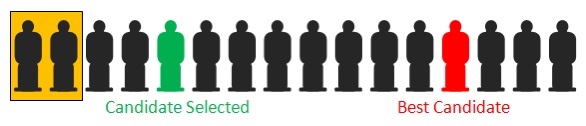
A common sense approach to the science of probabilities tells us that the more we look for something the higher our chances of finding the thing that we are looking for. For instance, the law of large numbers in mathematics describes that the true probability of something occurring can only be tested if we try that thing a large number of times and the more we try something the more accurately the results represent the statistical probability of something happening.
It is commonly believed that if we keep looking for something without ever giving up then we will eventually find it, so according to this belief if you want the next high paying client just keep prospecting and presenting your product or service to more and more people until you find the best possible client who pays more than all the previous prospects. Also in this way, if you want to find the ideal mate then you need to keep going on dates with more and more potential mates until you find the person who is the best option. That is by no means limited to finding the right person in your business or personal life as the same approach can be used to find the right career, the right property, the right travel agency, and so on!

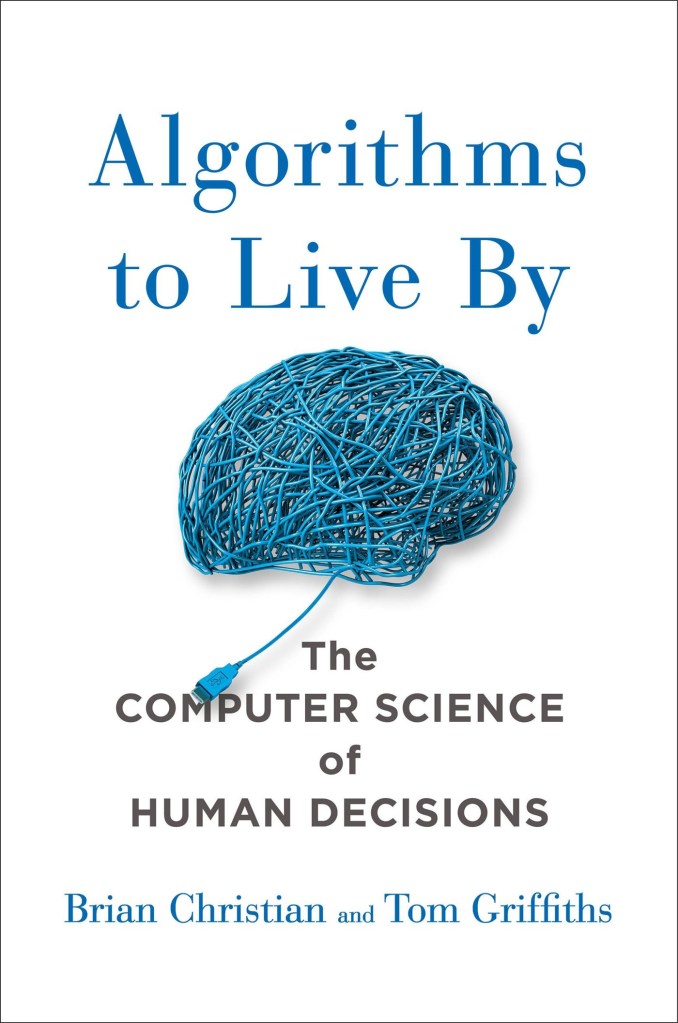
However, this common belief that drives many of us to keep searching and examining the next best thing lacks a substantial component: a break! When do we know when to stop and assume that the current option chosen is indeed the best option? After all, the grass is always greener on the other side. In the book Algorithms to Live By: The Computer Science of Human Decisions by Brian Christian and Tom Griffiths the authors propose an algorithmic solution backed up by the same mathematics that powers up some of the most advanced forms of artificial intelligence. Their solution is what mathematicians call optimal stopping.
According to the book, on the quest to finding the best option in the shortest amount of time we need to avoid choosing the first few options since the odds are the first few options are not the best but at the same time we also should avoid keep moving on to the next and the next hoping that every subsequent option has a higher chance of being superior since it simply does not! That is precisely why we need to stop at the optimal time, which is to say, not too early and not too late!
For instance in your search for the right apartment, deal, spouse, university, etc you are better off not taking the very first few options that become available since the chances are there are other superior options available to you should you just continue your search; however, if after examining a few options you found that superior candidate then you should stop optimally and settle for that superior option assuming that from then on you will encounter with options that will be inferior to your current selected option or if there are any real superior options they will take you again through many inferior options until you find it which substantially increases the cost of finding an option that might be just a tad better than the good option you would have had if you had but stopped optimally saving a tremendous amount of time and resources in the process.

Optimal stopping which is an algorithm extracted from the renowned secretary puzzle is simply about getting the best option at the optimal cost by refusing to accept the first option offered and continuing to look for superior options while avoiding the trap of an endless search. By stopping not too early and not too late we can insure the best decision at the most optimal cost, so for instance if there are 15 applicants available for a position it is best to give the job to the 9th or 10th applicant who fits the job description and call it a day.

Using the principle of optimal stopping, which is one of the algorithms that some of the best types of artificial intelligence use to make decisions can be of immense help for humans in making decisions all across the board that bring about the best results at an optimal cost of time and other resources required to examine further options. So when you look for the next best thing, wait a little and examine further options but don’t wait too long, stop optimally!

 Daniel Molgan Official