
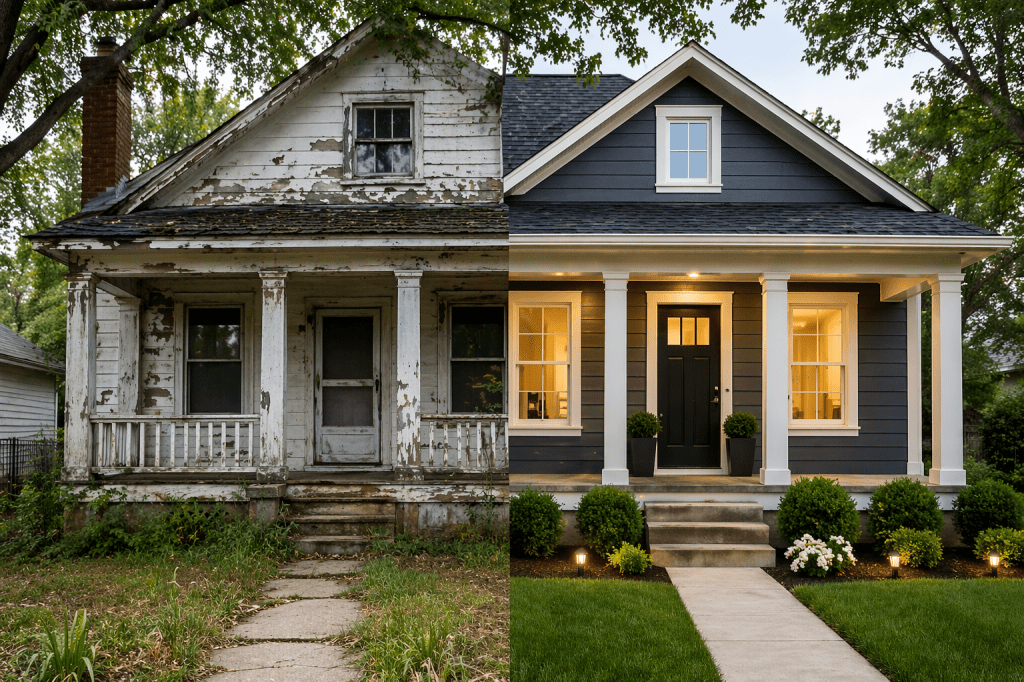
For years, the narrative around housing in America has been simple: rising interest rates, declining affordability, and a shortage of entry-level homes. Many believed that house flipping was a fading strategy, waiting for lower rates to make a comeback.
That assumption turned out to be completely wrong.
House flipping didn’t disappear. It evolved. And in 2025, it quietly became one of the most important forces shaping the entry-level housing market.
Flippers vs. Builders: A Dramatic Shift in Supply
A recent report by New Western revealed a surprising reality:
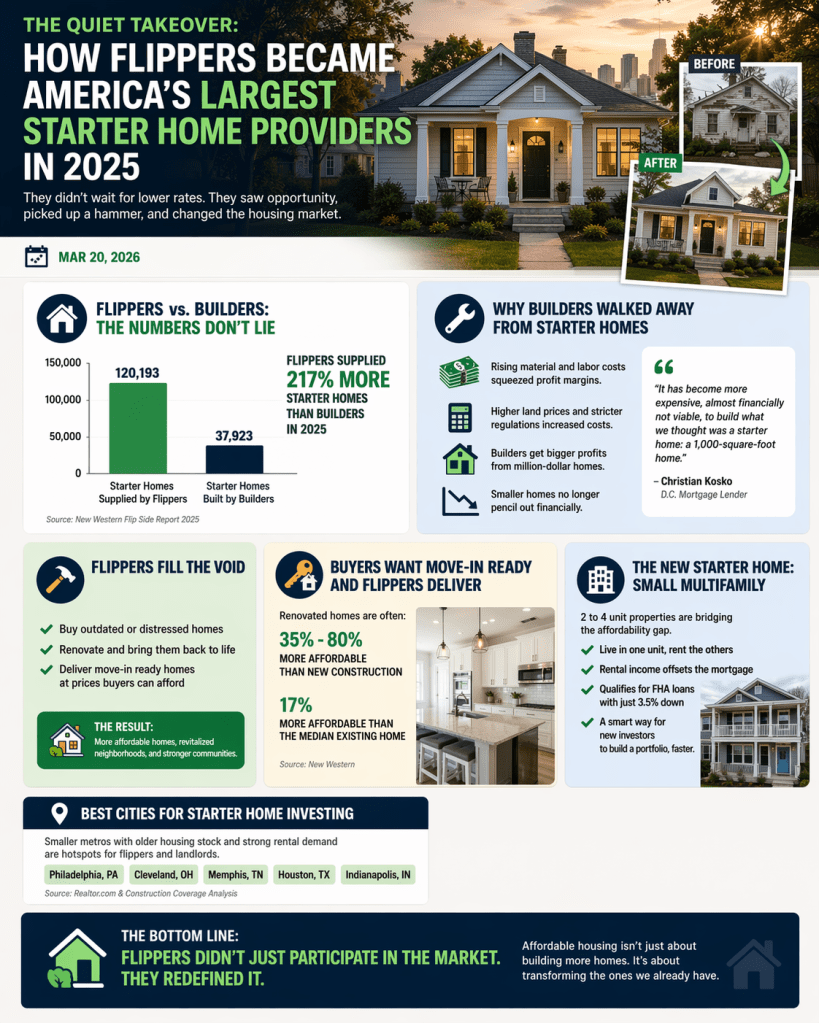
Local investors supplied over 120,000 starter homes in 2025, compared to just under 38,000 built by developers.
That’s more than 3 times as many homes coming from flippers than from builders.
This is not just a statistic. It represents a structural shift in how affordable housing is created in the United States.
For decades, builders were the primary suppliers of starter homes. Today, they’ve largely abandoned that role.
Why Builders Walked Away From Starter Homes
To understand this shift, you need to understand one simple truth: starter homes no longer make financial sense for builders.
Several forces collided:
1- Rising material costs
2- Labor shortages
3- Higher land prices
4- Increased regulatory burdens
5- Interest rate volatility
Together, these factors squeezed margins on smaller homes.
Instead of building 1,000 square foot entry-level houses, developers pivoted toward higher-end properties where profits are significantly larger. In many markets, building anything under mid-range pricing simply doesn’t pencil out.
Even attempts to shrink home sizes after rate hikes in 2022 failed to restore affordability. Prices rose faster than cost savings.
The result: a massive gap at the bottom of the market.
The 4 Million Home Gap and a Hidden Opportunity
According to estimates cited by Realtor.com, the U.S. still faces a housing shortage of around 4 million homes.
But here’s the twist:
The problem isn’t just a lack of new construction. It’s also the underutilization of existing housing stock. Across the country, millions of older homes sit in various states of disrepair: Outdated interiors, deferred maintenance, vacancy or underuse, inherited properties with no upgrades, these properties are often invisible to traditional buyers.
But to investors, they represent opportunity.
Flippers: The New Supply Chain of Affordable Housing
Instead of building new homes, flippers are recycling existing ones.
They acquire distressed or outdated properties, renovate them, and return them to the market as move-in-ready homes.
This approach solves multiple problems at once:
1- It increases supply without new land development
2- It revitalizes aging neighborhoods
3- It delivers homes at lower price points than new construction
In fact, renovated homes are often: 35% to 80% cheaper than new builds, below median market prices in many areas and this makes them highly attractive to first-time buyers, young families, downsizing homeowners, cash flow investors
Flippers are not just investors anymore. They are effectively micro-developers operating at scale.
The Rise of Move-In Ready Demand
Another major trend accelerating this shift is buyer preference.
According to insights shared in Forbes real estate coverage, demand is increasingly favoring fully renovated, turnkey properties.
Why?
Because renovation has become harder for the average buyer.
Material costs remain high
Contractor availability is limited
Project timelines are unpredictable
Buyers are no longer eager to take on fixer-uppers. Instead, they’re willing to pay a premium for certainty.
This has created a pricing divergence:
Homes needing renovation are stagnating or declining in value
Renovated homes are seeing stronger demand and price growth
For flippers, this is the ideal environment.
Starter Homes as an Investment Engine
Starter homes are no longer just an entry point for buyers.
They are becoming the core asset class for investors.
For flippers, the strategy is straightforward:
Buy distressed property
Renovate efficiently
Sell into high demand
For landlords, the opportunity goes deeper:
Acquire renovated homes below replacement cost
Generate stable rental income
Refinance when rates decline
This is especially powerful in the context of the BRRRR strategy: Buy, Rehab, Rent, Refinance, Repeat.
With a large pool of aging housing stock, this cycle can be repeated across multiple markets.
The New “Starter Home”: Small Multifamily Properties
Interestingly, the definition of a starter home is also evolving.
Data from the National Association of Home Builders shows that 2 to 4 unit properties are increasingly filling the affordability gap.
These small multifamily homes offer a unique advantage:
Owner-occupants can live in one unit
Rental income from other units offsets the mortgage
This creates a powerful entry point into real estate ownership.
Even better, many of these properties qualify for FHA financing with as little as 3.5% down.
For new investors, this opens a scalable path:
Buy a duplex or triplex. Live in one unit. Rent the others. Refinance and repeat Over time, this can build a sizable portfolio with relatively low capital.
Where the Opportunity Is Growing
Not all markets are equal. Starter home investing tends to perform best in:
1- Midwestern cities
2- Northeastern metros
3- Southern growth markets
These areas share common characteristics:
Lower acquisition costs
Older housing stock
Strong rental demand
Less restrictive zoning
Cities like Philadelphia, Cleveland, Memphis, and parts of Texas are increasingly attractive for both flipping and long-term holds.
The Bigger Picture: A Structural Transformation
What we’re seeing is not a temporary trend.
It’s a fundamental shift in how affordable housing is created.
Builders are focused on high-margin developments
Flippers are supplying entry-level inventory
Multifamily is redefining affordability
Buyers are prioritizing convenience over renovation
This creates a new housing ecosystem where:
Supply comes from renovation, not just construction
Investors play a central role in affordability
Older homes become the backbone of the market
Solving the housing crisis through rehabilitation
The biggest misconception in real estate today is that solving the housing crisis requires building more homes.
That’s only half the story.
The other half is already here, hidden in plain sight:
Millions of underutilized properties
Waiting to be transformed
By investors who understand the opportunity
In 2025, flippers didn’t just participate in the market.
They redefined it.
And if current trends continue, they won’t just remain relevant.
They’ll become indispensable.


